Hotline: 18459226877

Case Guides

Home / Case Guides / Details
BRICS Series Guide: Russia - Environmental Protection
Russia

1、 Related legislation;

Within the domestic legal system, Russia has formed an environmental and ecological system based on the Constitution, with specialized legislation and a series of supporting legislation complementing each other, and a relatively strict system.

As the fundamental law of Russia, the 1993 Constitution of the Russian Federation (hereinafter referred to as the "Constitution of the Russian Federation") stipulates the environmental rights of citizens and the obligations of the government and citizens to protect the environment in Article 9, Article 36 (2), Article 42, and Article 58, respectively. In addition, Russia has long been aware that environmental and ecological protection is a large-scale systematic project that needs to be regulated in basic departmental laws such as economic law, administrative law, criminal law, and civil law. Therefore, the 2013 Code of Administrative Violations of the Russian Federation, the 1996 Civil Code of the Russian Federation, the 1996 Criminal Code of the Russian Federation, and other laws contain a large number of environmental and ecological systems and norms. For example, the Code of Administrative Violations of the Russian Federation and the Civil Code of the Russian Federation have specific provisions on environmental administrative violations and their penalties, principles of attribution of environmental civil liability, and principles of environmental damage; And environmental crimes and punishments are regulated in a special chapter of the Criminal Code of the Russian Federation. It is worth noting that Russia has also formulated and promulgated a large number of specialized federal laws and policies related to environmental and ecological systems. In terms of federal legislation, there are mainly: the 2017 Russian Federation Environmental Protection Law (hereinafter referred to as the "Russian Federation Environmental Protection Law"), the 2017 Russian Federation Land Code, the 2007 Russian Federation Agricultural Development Law, the 1999 Russian Federation Resident Health and Epidemic Prevention Safety Law, the 1999 Russian Federation Atmospheric Protection Law, the 1992 Russian Federation Underground Resources Law, the 1993 Russian Federation Forest Legislation Outline, the 1995 Russian Federation Special Protected Natural Areas Law, the 1996 Russian Federation Resident Radiation Safety Law, the 2006 Russian Federation Water Code, the 1995 Russian Federation Ecological Appraisal Law, the 1995 Russian Federation Atomic Energy Utilization Law, and the 1995 Russian Federation Animal Protection Law. The law The 1996 Russian Federation Law on State Regulation of Genetic Engineering Activities, the 1997 Russian Federation Forest Code, the 1998 Russian Federation Law on Production and Consumption Waste, and the 1997 Russian Federation Law on the Safe Use of Pesticides and Agricultural Chemicals, among others. In terms of policy, Russia mainly issues numerous environmental and ecological normative legal documents in the form of federal presidential decrees, directives, and federal government decisions and instructions. Such as the 1994 Basic Regulations of the Russian Federation on the National Strategy for Environmental Protection and Sustainable Development, the 1996 Basic Concept for Sustainable Development of the Russian Federation, the 2014 Decision on Establishing a Unified National Ecological Monitoring System, and the 2015 National Ecological Appraisal Regulations.

The basic environmental protection laws in Russia are the Environmental Protection Law and the Ecological Assessment Law.

In 2002, Russia promulgated the national Environmental Protection Law. This law is the fundamental law for formulating environmental policies, ensuring coordinated socio-economic development, maintaining ecological and resource diversity, and ensuring national ecological security. The objects covered by this law include land, minerals, soil, surface water and groundwater, atmosphere, flora and fauna, and other organisms, as well as natural environments and resources such as the ozone layer and near Earth space. It sets environmental requirements for the entire process of layout, design, construction, production, operation, suspension, and liquidation of various economic activities such as construction, agriculture, mineral development, military and national defense, and clarifies property responsibility, administrative responsibility, and criminal responsibility for violations of environmental protection regulations. In addition, the Ecological Assessment Law is also one of the basic environmental laws in Russia. The law stipulates that the relevant documents of business activities related to the object of ecological assessment must be evaluated to confirm their compliance with technical regulations and legal requirements in the field of environmental protection, and to prevent the activity from having a negative impact on the environment.

& nbsp;

2、 Environmental regulatory authorities;

The Russian Ministry of Natural Resources and Ecology (website: www.mnr. gov.ru/) is responsible for formulating national policies and implementing management in the field of environmental protection and ecological security, and coordinating the work of other federal executive agencies. The main functions of this department include: formulating and organizing the implementation of federal target outlines for geological and mineral development and utilization, water resource protection, forest resource utilization and regeneration, and environmental protection, and implementing a licensing system; The national registration system for environmental polluting enterprises; 29 functions include evaluating the impact of human economic and other activities on the environment.

The subordinate agencies of this department involved in environmental management include the Russian Federation Natural Resources Utilization Supervision Agency, the Russian Federation Mineral Resources Utilization Supervision Agency, the Russian Federation Water Resources Agency, the Russian Federation Water Resources, Weather and Environment Monitoring Agency, and the Russian Federation Forestry Resources Agency.

In addition, Russia's Ministry of Natural Resources and Ecology has close ties with the Health and Epidemic Prevention Supervision Station of the Ministry of Health, the National Fisheries Commission, the Ministry of Agriculture, the National Standards Committee, the Ministry of Economic Development, the Ministry of Taxation, the Ministry of Justice, the Ministry of Atomic Energy, and others in the field of environmental protection, working together to do a good job in national environmental protection.

& nbsp;

3、 Compliance requirements;

1. Environmental permit system;

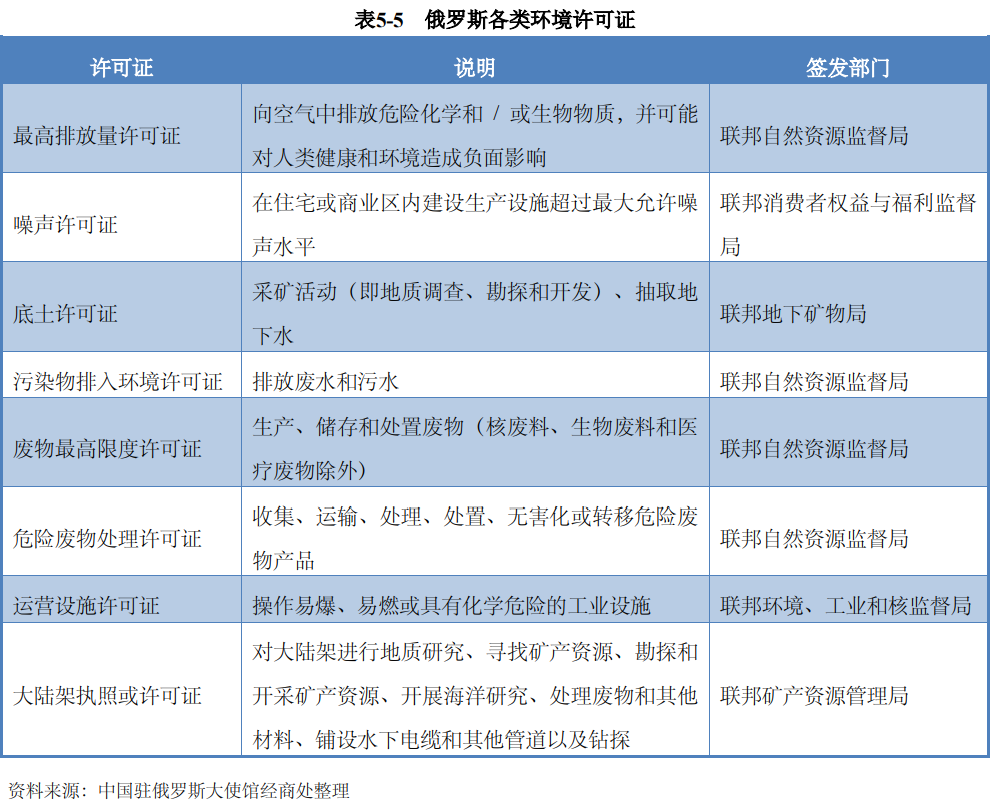
Russia implements a single environmental permit system and does not have a unified comprehensive permit. Business activities involving emissions, water, noise, exhaust gas, etc. require corresponding permits to be obtained separately.


 < /p>

2. Environmental Impact Assessment;

The Russian Federation Ecological Assessment Law stipulates that business activities related to ecological assessment objects must be evaluated to confirm their compliance with technical regulations and legal requirements in the field of environmental protection, and to prevent negative impacts on the environment. The Russian Ministry of Construction and Housing Public Utilities has established a National Appraisal Bureau, and foreign-funded enterprises investing and building factories in Russia need to provide environmental impact assessment reports to this department.

Foreign funded enterprises investing and building factories in Russia are required to provide an environmental impact assessment report to the State Administration for Market Regulation. Provide project environmental impact assessment reports in the preliminary design plan for general projects, and submit environmental impact assessment reports before design for high pollution projects. The production of ecological exploration reports needs to be entrusted to qualified laboratories or companies. The task book for ecological report production is provided by the design institute, and after the report is completed, the laboratory or company will go to the relevant department for approval. The production and approval process takes approximately 2-3 months. The cost depends on the project scale and nature, building area, excavation depth, soil sampling, and other factors.

& nbsp;

4、 Environmental damage punishment;

Legal and natural persons must compensate for all losses caused by environmental pollution, depletion, damage, destruction, unreasonable use of natural resources, degradation and destruction of natural ecosystems, natural complexes, and natural landscapes, as well as other violations of environmental protection regulations. Environmental damage caused by economic activities and other entities shall be compensated according to the calculation table and method of environmental damage amount. In the absence of such calculation table and method, compensation shall be made based on the actual cost or loss incurred in restoring the damaged environmental condition.

Lawsuits for compensation for environmental damage caused by violations of environmental protection regulations can be filed within a 20-year period. Due to non-compliance with relevant regulations leading to environmental pollution, citizens can be fined up to 10 times their salary, officials can be fined up to 20 times their salary, and enterprises can be fined up to 500000 rubles.

& nbsp;

& nbsp;

Reference:;

1. https://www.mofcom.gov.cn/dl/gbdqzn/upload/eluosi.pdf< ;/a>

three https://mp.weixin.qq.com/s/tNcfzWqIf092YD8myqu1kg< ;/p>

& nbsp;

& nbsp;

More Cases